

Carry Home Initiative Offers Support To Local Foster Children
Detail page
October 27, 2026 – There are over 328,000 children in the U.S. in the foster care system, and over 110,000 are waiting to be adopted. Hundreds of thousands of youths enter and exit the system each year. Life as a foster child often includes frequent moves, with many children having nothing more than a garbage bag to store and transport their belongings. B.J. Wagner, the Meadows Institute’s executive vice president for health and public safety, saw this growing need and identified a way that local police agencies and law enforcement could give back to their communities in a tangible way.
If you’ve ever attended a conference, you are likely familiar with branded swag items. Conferences and events across the nation provide attendees with branded journals, pens, tote bags, etc. which often end up discarded or left behind in hotel rooms. After attending several conferences for the International Association of Chiefs of Police (IACP), Wagner, a former police officer and community mental health professional, took note of the brand-new, high-quality backpacks provided to registrants and an idea began to form: What if there was a way that unused backpacks could be donated to local foster kids?
Over the years, Wagner began donating backpacks she collected from colleagues at conferences and events to her local Children Without Placement CPS offices. At last year’s IACP Conference in Denver, Wagner asked the IACP to donate all unclaimed bags resulting in over 1,000 backpacks donated to local foster care agencies, officially launching the “Carry Home” initiative.
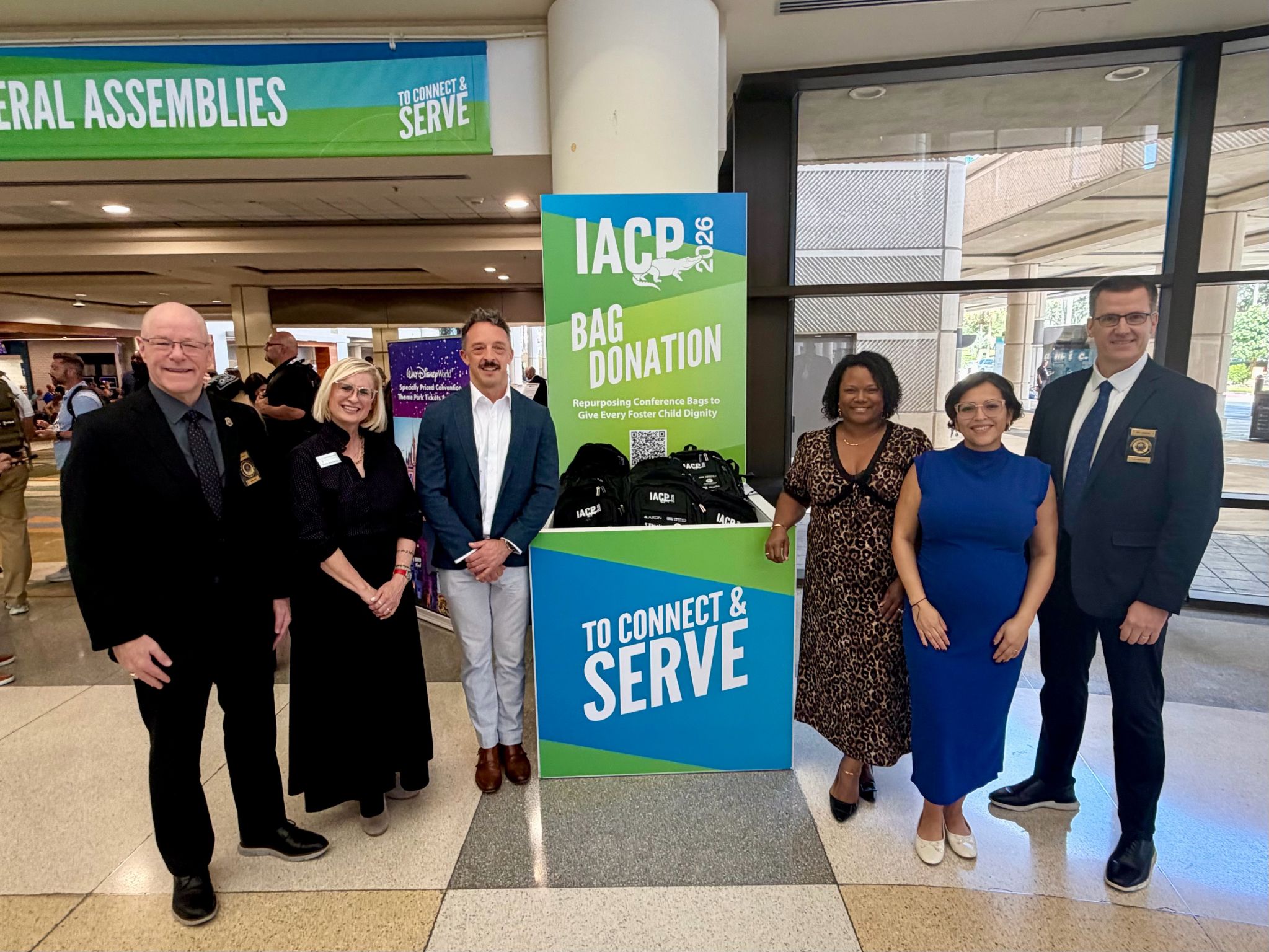 (From L-R) David Rausch, Tennessee Bureau of Investigation and IACP President, Deni Sunderly, Foundation for Foster Children, Chris Fisher, Meadows Mental Health Policy Institute, Raquel Bell, Foundation for Foster Children, Carmen Garcia, Foundation for Foster Children, and Will Johnson, BNSF Railway Police and incoming IACP President
“The challenges these kids face are complex, but helping doesn’t have to be. Often the most meaningful response is a simple one, like putting resources we already have into the hands of the kids who need them,” said Wagner.
This year, IACP formalized the initiative as part of their annual conference. Here’s how it works: A sign at the registration stand of the conference informs attendees that if they don’t want their backpack, they can donate it to local foster youth, with a QR code linking to more information about the program. Collection receptacles and QR codes are placed throughout the conference space for additional donation opportunities. Those who choose to donate will opt in at the time of check in or simply drop it at one of the marked “Carry Home” bins near expo exits and registration, where it will be collected after the conference to be formally donated to foster care organizations in the area.
At this year’s IACP conference, an expected 1,000 sturdy bags are heading home to youth in three ways:
- Foundation for Foster Children: to children in foster care and children facing sudden removal from their homes
- Orange County Sheriff’s Office (OCSO): to children involved in traumatic events who need to pack quickly
- OCSO School Resource Officer program: to children who need school supplies
To make this initiative a reality, the Meadows Institute partnered with the Florida Chamber Foundation to donate the backpacks. The foundation’s Florida Prosperity Initiative is committed to ending generational poverty for children in Florida, many of whom are in the foster care system, and the “Carry Home” initiative seeks to honor that commitment. Local partnerships such as this one are crucial to the project’s success to ensure that the donations are effectively helping those who need the products most.
Although significant progress has already been made, supporting these kids doesn’t stop with just the bags.
Wagner already has plans to start formalizing items inside the backpack for next year’s conference.
“The backpacks are just the beginning. Next year, we hope to fill each one with essentials a child needs during a placement. Every conference hands out items that go unused, so any profession can do this. My hope is that Carry Home becomes a model that other associations adopt and make their own.”