

Strengthening Juvenile Justice Across the Continuum in Texas
Detail page
What does it take to build a juvenile justice system that connects young people to the right services, keeps them closer to home, and prevents unnecessary involvement in the justice system?
That question was at the heart of a recent presentation at the Judicial Summit on Mental Health, hosted by the Texas Judicial Commission on Mental Health, where the Meadows Mental Health Policy Institute and the Texas Juvenile Justice Department (TJJD) shared findings from their statewide Juvenile Justice Continuum of Care (CoC) assessment, and, more importantly, what Texas is doing with those findings.
Layla Fry, Vice President for Youth Justice and Family Policy at the Meadows Institute, joined TJJD’s Matt Smith, Director of Statewide Youth Services Continuum, and Gabriel Grady, TJJD’s Southeast Regional CoC Coordinator, to discuss how the state is moving from assessment to implementation.
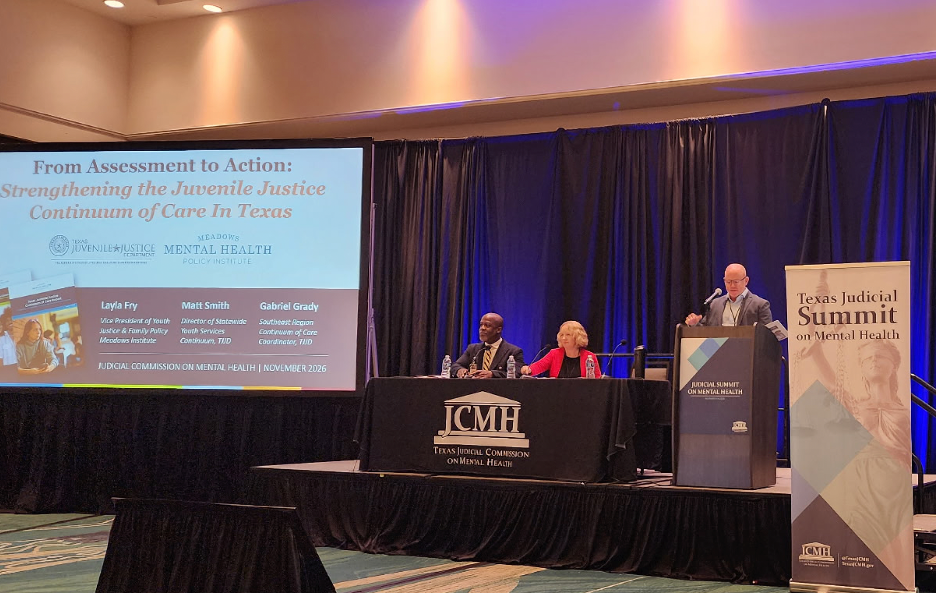 The Meadows Institute’s Layla Fry presents on a panel at the Judicial Summit on Mental Health, hosted by the Texas Judicial Commission on Mental Health
The Meadows Institute’s 2026 assessment, which included extensive data analysis and input from practitioners, families, and community partners across all seven TJJD regions, revealed three major opportunities for improvement:
- Move diversion further upstream. Too many young people enter the justice system for behaviors and needs that could be addressed earlier by schools, behavioral health services, and community-based supports.
- Strengthen shared responsibility across systems. When other systems cannot meet young people’s needs, juvenile justice often becomes the provider of last resort.
- Make the system work better. Not every problem requires a new program. Sometimes the biggest barriers are outdated policies, lengthy delays, complicated referral processes, or existing resources that aren’t being fully utilized.
But the conversation did not stop at identifying problems.
The presenters explained how TJJD is using the findings to guide its 10-year strategic plan, regionalization efforts, funding priorities, and the creation of new regional CoC Coordinator positions across Texas. Gabriel Grady shared examples of how the southeast region is putting recommendations into practice through the Southeast Collective, bringing 19 juvenile departments and community partners together to tackle shared challenges and improve treatment access and diversion from the system.
For the judges, attorneys, juvenile probation professionals, and behavioral health providers in the audience, the message was practical: meaningful change does not always have to start with a major new investment. It can begin by identifying one place where young people are getting stuck, bringing the right partners together, and changing how that part of the system works.
As the presenters emphasized, having a collection of programs does not necessarily mean there is a functioning continuum of care. What matters is how well those programs, policies, and systems work together for young people and families.
With seven regional playbooks, a comprehensive statewide report, and a growing infrastructure for implementation, Texas has a roadmap for making those connections stronger.
Now comes the important part: putting it to work.